Synthetic Biology Equipment to Lease by Stage: Guide for Biotech Operators
Last Updated on
December 10, 2025
By
Excedr
If you’re leading a synthetic biology startup, you already know that building a high-quality lab is more than just filling a space with shiny equipment. Every piece of gear you bring in is a strategic decision that affects your burn rate, your ability to hit milestones, and your team’s day-to-day productivity. The stakes are high: over-invest and you risk tying up precious capital; under-invest and you bottleneck your science.
But here’s the real challenge—your needs change fast. What works for a three-person team in an incubator won’t cut it once you’re running multiple programs or scaling up production. That’s where equipment leasing comes in: a flexible, often underutilized tool for keeping your lab nimble, your budget predictable, and your options open.
In this guide, we’ll break down how to approach leasing lab equipment at each stage of your company’s growth, with practical advice for founders, lab managers, and anyone else making operational calls under pressure. Whether you’re outfitting your first bench or scaling up to commercial production, the right leasing strategy can be a game-changer.
Why Leasing Makes Sense in Synthetic Biology
Leasing lab equipment isn’t just about spreading out payments—it’s about staying agile in a field where both your science and your business can pivot overnight. Whether that’s a boring but essential tool or a cutting-edge system.
Here’s what makes leasing especially relevant for synthetic biology startups:
- Preserve your runway: Every dollar you don’t sink into capital equipment is a dollar you can put toward R&D, hiring, or that next key experiment. Leasing keeps your cash flow flexible, which is critical when milestones and funding rounds are always top of mind.
- Stay nimble as needs change: Synthetic biology is fast-moving by nature. New protocols, shifting project priorities, and evolving team size can all change your equipment needs in a matter of months. Leasing lets you scale up—or down—without being locked into yesterday’s decisions.
- Access the latest tech: Equipment cycles are getting shorter. That high-end sequencer or liquid handler you need today might be outdated in two years. Leasing gives you a path to upgrade as technology advances, without the pain of sunk costs.
- Simplify maintenance and support: Many leases bundle in service, calibration, and repairs. That means fewer surprise expenses and less downtime—so your team can focus on science, not troubleshooting.
- Reduce risk: If a project pivots or funding dries up, you’re not stuck with a warehouse full of expensive, underused gear. Leasing helps you match your commitments to your actual needs.
Of course, leasing isn’t a silver bullet. For some equipment—especially workhorse tools you’ll use for years, or items with strong resale value—buying outright can make sense. The trick is knowing when to lease, when to buy, and how to make the call based on your stage and strategy.
Ready to see how this plays out at each phase of company growth? Let’s start with early-stage teams and incubator labs.
Stage 1: Incubators, Pre-Seed, and Seed-Stage Startups
In the earliest stages of biotechnology startup life, your team is small, your budget is tight, and your roadmap is likely to change. Maybe you’re working out of a shared incubator, or you’ve just landed your first few benches. Every equipment decision feels high-stakes—because every dollar and every square foot matters.
What to Lease (and Why)
- Core lab essentials: Centrifuges, refrigerators, biosafety cabinets, and basic incubators—these are your wet lab workhorses. Leasing lets you get operational quickly without burning through your seed capital.
- Specialized instruments for assays: Running daily qPCR assays but always fighting for time on the shared machine? Leasing your own qPCR instrument can keep your timelines on track and reduce workflow bottlenecks, without the upfront cost of buying.
- Office and IT Infrastructure: Don’t underestimate the basics—computers, desks, even printers can be leased. This keeps more cash available for experiments and hiring.
Operator Insights: Flexibility Is Your Friend
Flexibility is such an important part of staying healthy and active. So it's no surprise that flexibility in business is good for long-term health as well.
Here's a few insights from our experience working with labs over the last decade:
Lease only what you need now. It’s tempting to outfit your lab for every possible scenario, but resist the urge. Focus on what you need for your next set of experiments, not for a hypothetical future.
Negotiate short-term leases if they're available. Can you secure leases that let you scale up, swap out, or return equipment if your project pivots or funding gets delayed? Flexibility in contract terms can be a lifesaver. That said, longer term leases won't be as expensive on a monthly basis. So it can really depend on what your monthly spend looks like.
Leverage shared resources first. Before leasing, double-check what’s available through your incubator or local core facilities. Sometimes, paying per-use or access fees is more cost-effective—and less risky—than leasing your own gear.
Pressure-test your assumptions. Ask yourself: If our science or funding shifts, how easily can we unwind these commitments? Am I confident this piece of equipment will be essential for the next 6–12 months?
Common Pitfalls to Avoid
While these might never be things you have to deal with, it's helpful to know what to look out for. Here are some pitfalls we've seen firsthand.
- Locking into long term leases way too early: Committing to multi-year leases before you have product-market fit or stable funding can box you in if your plans change.
- Overcommitting to equipment: Buying or leasing more than you need ties up capital and space. Remember, you can always add more as your needs become clearer.
- Overlooking hidden costs of ownership/additional lease terms: Watch for insurance, delivery, and required maintenance fees. Does the lease include service, calibration, and support? Make sure you know who’s responsible for what.
- Leasing when you could use shared equipment first: Don’t lease specialized equipment if you can get reliable access through a core facility or incubator. Double-check availability and reliability before making the leap.
Leasing is a great option—don’t get us wrong. But we want you to go in clear-eyed. There are pitfalls that can sneak up on you if you're not paying attention, and it's better to know them early. In the beginning, your goal should be to stay lean and focused on validating your science—not locking up capital or getting stuck with gear you might not actually need.
Figure out what works, then evaluate your options. Leasing can be a smart move, especially if the terms are favorable and the monthly payments help you control burn. The right lease structure can keep your lab nimble and extend your runway.
Stage 2: Series A–B, Dedicated Lab Buildout, and Early Scale-Up
At this stage, you’ve landed significant funding, your team is growing, and you’re likely moving into a dedicated lab space. The pressure is on to hit technical milestones, scale up experiments, and prove your platform’s value. Your equipment needs are more complex, and your operational risks are higher.
What to Lease (and Why)
- Advanced instrumentation: Automated liquid handlers, flow cytometers, plate readers, and chromatography systems become essential as you increase throughput and complexity. Leasing these high-cost, rapidly evolving tools helps you avoid large capital outlays and keeps your lab current.
- Custom or modular build-outs: As you expand, leasing tenant improvements—like specialized benches, HVAC upgrades, or clean rooms—can smooth cash flow and let you adapt your space as your needs change.
- Pilot-scale bioreactors or fermenters: If you’re moving from bench to pilot scale, leasing allows you to ramp up capacity for process development or scale-up runs, without betting the farm on equipment you might soon outgrow.
Operator Insights: Scale with Agility
- Match lease terms to project milestones: Will this equipment still be essential in 18 months? Make sure your lease aligns with your program timelines and go/no-go decision points.
- Negotiate for upgrades and flexibility: Can you trade in or upgrade equipment as your needs evolve? Ask about options to swap out instruments or expand capacity mid-lease.
- Integrate maintenance and support: Bundled service, calibration, and support in your lease agreement can minimize downtime and reduce surprise costs—critical when you’re running at higher volumes.
- Coordinate with finance and ops: How do lease payments fit into your burn rate and fundraising plans? Work closely with your finance team to model cash flow impacts and avoid surprises.
Common Pitfalls to Avoid
- Misaligned lease terms: Getting stuck with equipment after a program is deprioritized or timelines shift can tie up resources and space.
- Underestimating support needs: Don’t overlook the importance of bundled maintenance—downtime from repairs or calibration issues can derail critical experiments.
- Overcommitting on custom build-outs: Leasing too much specialized infrastructure can limit your flexibility if your science or team size changes.
- Ignoring regulatory and data needs: As you scale, ensure leased equipment meets data integrity, traceability, and compliance requirements—especially if you’re preparing for clinical or regulatory milestones.
At this stage, leasing is about scaling efficiently, staying technologically current, and preserving your ability to pivot as your science and business evolve.
Stage 3: Late-Stage, Commercialization, and Manufacturing Scale-Up
By the time you’re approaching late-stage development or commercialization, your team is larger, your workflows are more complex, and regulatory scrutiny is part of daily life. You’re focused on reliability, quality, and throughput—often under the watchful eye of partners, investors, or regulators. Capital may be less constrained, but operational risk and timelines matter more than ever.
What to Lease (and Why)
- Production-scale bioreactors, fermenters, and downstream processing equipment: Leasing large-scale production equipment can bridge the gap as you ramp up manufacturing or validate processes before a full capital commitment. This is especially useful if you’re piloting new products or scaling up in phases.
- Quality control and regulatory testing instruments: Analytical tools for environmental monitoring, release testing, and validation (think HPLC, mass spectrometry, or automated microbial detection) can be leased to keep your QC and compliance functions flexible as volume and regulatory needs grow.
- Facility infrastructure: Major upgrades—like GMP-compliant clean rooms, large-scale HVAC systems, or modular suites—can often be leased or financed. This helps you avoid massive upfront spend and lets you match infrastructure scale to actual demand.
Operator Insights: De-Risk and Future-Proof
- Align lease terms with regulatory and launch timelines: Does your lease support your anticipated product launch, validation, or regulatory milestones? Avoid mismatches that could leave you scrambling or overcommitted.
- Plan for upgrades and capacity increases: Are you likely to need more capacity or newer tech in the next 12–24 months? Look for lease agreements that allow for expansion or equipment swaps as your manufacturing ramps up.
- Factor in validation and compliance support: Can your leasing partner provide the documentation, validation, and service records needed for regulatory audits? Make sure your lease covers these essentials.
- Understand total cost of ownership: Model out what happens if you extend the lease, buy out the equipment, or need to terminate early. Surprises at this scale can be expensive.
Common Pitfalls to Avoid
- Neglecting regulatory documentation: Not all lessors are equipped to provide the validation packages and compliance support required for GMP or commercial operations. Don’t assume—ask.
- Underestimating facility complexity: Scaling facility infrastructure is a major undertaking. Work with partners who understand GMP and late-stage requirements, not just basic lab buildouts.
- Overlooking end-of-lease scenarios: Know your options for buyout, renewal, or equipment removal at the end of the lease. Plan for transitions well in advance.
- Failing to integrate with supply chain and ops: As your operations scale, make sure your leased equipment and infrastructure integrate smoothly with your broader supply chain, logistics, and quality systems.
At this stage, leasing is about de-risking scale-up, maintaining operational flexibility, and ensuring compliance—so you can focus on launching and delivering your product without unnecessary capital drag.
Practical Tips for Leasing at Any Stage
No matter where your company sits on the growth curve, a smart leasing strategy comes down to asking the right questions and collaborating across teams. Here are some operator-tested tips to keep your lab efficient and your risk low:
- Start with a needs assessment: Map your scientific and operational requirements to your business milestones. What do you absolutely need for the next 6–12 months? Don’t lease more than you need, but don’t under-equip your team either.
- Vet your leasing partner: Look for lessors with real experience in biotech and synthetic biology. A partner who understands your timelines, compliance needs, and risk profile is worth their weight in gold.
- Negotiate for flexibility: Push for options to upgrade, trade-in, or terminate early if your needs change. Ask about bundled service, calibration, and warranty terms—these can save you both time and money.
- Model cash flow impacts: Work with your finance team to understand how lease payments fit into your budget and fundraising plan. Factor in tax implications, potential buyout scenarios, and how lease liabilities show up on your balance sheet.
- Avoid hidden costs: Read the fine print for early termination fees, maintenance responsibilities, insurance requirements, and end-of-lease options. Surprises here can bite into your runway.
- Loop in your lab and ops teams: Procurement, lab managers, and scientists all have different priorities. Make sure everyone’s voice is heard before you sign—what looks good on paper might not fit your actual workflow.
Leasing can be a powerful lever for efficiency and flexibility—but only if you approach it with the same rigor you bring to your science and business planning.
Sample Synthetic Biology Equipment to Consider Leasing
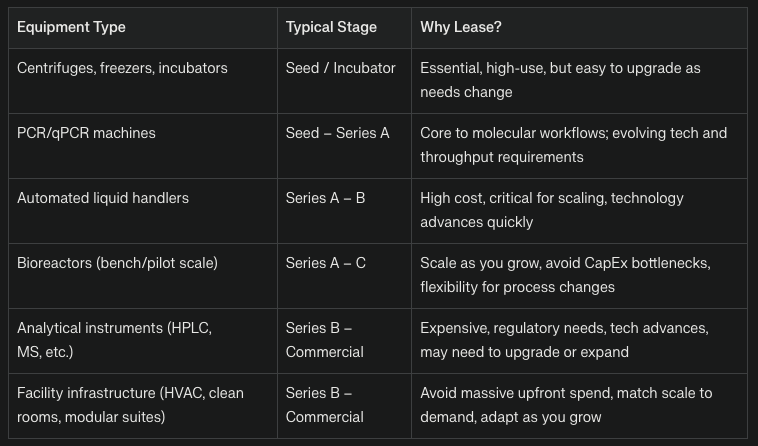
Think of this as a starting point, not a checklist. Your actual needs will depend on your science, your team, and your growth trajectory. Use it to spark discussion with your lab, ops, and finance team as you map out your next phase.
The Bottom Line
Leasing isn’t magic, and it won’t fix a broken workflow or a fuzzy roadmap. But used strategically, it can keep your lab moving, preserve your runway, and help you avoid explaining a warehouse full of idle equipment to your board.
Treat your leasing decisions like any other experiment: define your success metrics, track the impact on your burn and your milestones, and be ready to pivot if the numbers—or your science—change. The best operators revisit their equipment strategy regularly, using real data from their own workflows and budgets.
In the end, leasing is just one lever. Pull it when it makes sense, skip it when it doesn’t, and always keep your eye on what matters most: building a life science company that lets your team deliver results, not excuses.